17 Ways to Resist Capitalism
As I have spent the last two decades becoming an adult, one lesson that continues to ring true is how powerful and important purchasing decisions are. Though this is true everywhere, the prevalence of capitalism in the USA and the direct impact of my choices on the world around me is something I am reminded of daily, They reach from my community to communities across the globe.
Our money is power and when we give it to a company, we are giving them power. From Target to Amazon, we as a society are paying closer attention to a company’s expressed values versus actions, ethics, treatment of employees, political engagement, sourcing conditions, and so much more. But the more we dig, things seem worse than we realized and every purchasing decision can feel doomed to support something unethical in the long run.
I sometimes find myself falling into the fallacy of thinking that if I cannot completely remove myself from the capitalist cycle of destruction, I should give up all efforts.
In moments like that, I try to remember that every action matters; it does not have to be all or nothing. Every time I reduce my consumption or opt out of supporting a company I know is unethical, is a win. Each instance, takes us one step closer to a better system. And if I can progressively adapt to alternative choices, step by step I will get closer to the total resistance I long for.
I have been gathering a list of the little ways I resist capitalism, that I believe are each powerful and add up to something big. Reminder, that we should each start wherever we can. Every act of resistance matters.
Transporation
The auto industry is huge. From vehicles to gas to car insurance, the expense consumes a large part of our budgets and is something many of us are reliant on daily.
Until 14 months ago, my husband and I were a two-car household. We often talked about our intention to downsize to a single-car household, but could never quite pull the trigger. From the environmental damage of vehicle emissions to the environmental injustice imposed by highways throughout neighborhoods in the US, we had reasons beyond our personal efforts at frugality.
Then, through an act of God, a tree fell on one of our cars, and we’ve been a one-car household ever since. This past year has inspired many workarounds that have illuminated how doable it is to make better transportation choices.
Carpooling
Several co-workers live within a few miles of me. Last year, we began carpooling, alternating who was driving throughout the week. This not only added a little fun to the morning, it also reduced the number of vehicles making the same trip unnecessarily.
Public Transit
After losing one of our cars, my husband and I began leaning into taking Atlanta’s metro system, MARTA (one of the stations is only five minutes from our house), and realized how much we love it. Parking in a metro area is not only expensive but, as a general rule, a headache. Taking the metro when possible, immediately removes several stressors from an experience, driving in Atlanta traffic and finding parking, to name the big ones. And walking from the metro station to my downtown office, which are only a few blocks apart, does wonders every day to help me reach my step goal.
Bicycling
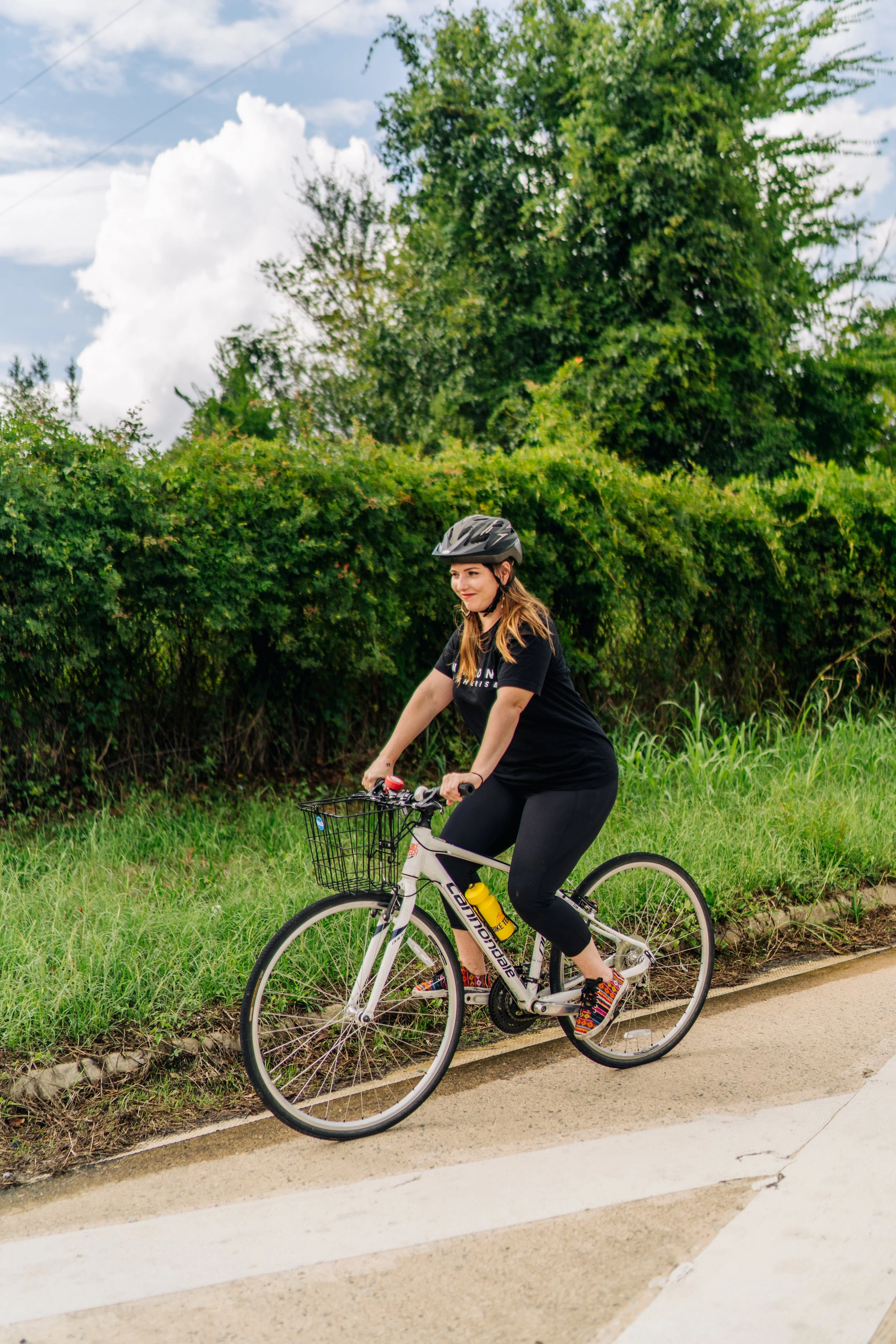
Riding a bike is great on its own or as a way to connect me from the MARTA station to my destination when it is not walking distance. It does take a few extra minutes before leaving the house to map out my route, but it often brings joy and enables me to go further without using a car.
Travel by bus or Train
Some trips must be made by air, but there are many domestic trips that can be made by bus or train. Similar to carpooling, these long-distance travel options are better for the environment. It also dovetails nicely with using the public transit system for the area you are visiting if it is available.
Clothing
Another huge industry and one wrought with ethical issues. The waste is astronomical and is only worsening year over year. I love expressing myself through style, so this is one I am very passionate about doing what I can to reduce supporting an industry that is profoundly damaging to our earth and many people on it.
shop second-hand
From consignment, to thrift stores, to online platforms devoted to re-selling, it has never been easier to opt for second-hand first. And the chances of finding what you are looking for are higher than ever. I can’t tell you how often I find clothing items in excellent condition, often with tags still attached, in thrift stores. It really is a gold mine. Of course, I love the fun of it, but more importantly, when shopping second-hand, we are reducing the demand for new goods. It really is a powerful choice.
clothes swap
Another great way to reduce the demand for fast fashion and new clothing items is to attend or host a clothing swap. This is when friends and acquaintances gather to exchange neglected items from their closets. Most of the time, groups opt to donate any leftover clothing to a shelter or another local nonprofit. It is conscientious and fun.
sewing
An imperfect option, considering the fabric may come through pipelines similar to the clothes I’m avoiding. Sewing my own clothes is something I have done off and on since making my Felicity doll’s clothes as a child. And while it is imperfect, it is still better than most other ways I could expand my wardrobe. I also love that it is an outlet for creativity and helps me break free from the trap of trends by empowering me to define my own style.
Produce
I know it can feel like there is little option here, but I want to explore ways within the general food category that can make a difference.
Reusable bags
It feels so small, if not insignificant, but consider the 40 million tons of plastic waste annually in the US. Bringing cloth produce bags and reusable shopping bags with you to the grocery store do play a part in reducing that number. A few things that help me remember to bring them are that I found ones I like (for me, the crocheted produce bags bring joy) and hanging them by the front door.
Avoid Single Serve
I also use reusable Ziplock bags at home when possible. Those, along with wax wrapping paper (to replace Saran Wrap) and reusable “paper” towels, are incorporated into my kitchen habits. They have not completely replaced disposable products, but have helped reduce dependence on the wasteful single-serve options.
At the office, our kitchen cabinets are filled with plastic forks, plates, cups, and more. It’s easy to reach for these when heating up lunch or enjoying a snack. But I keep a reusable cutlery set in my office that I opt for instead. When I’m at the office, I look for other little ways to avoid unnecessary waste, which is easy once the habit is built. Putting my trash in the kitchen waste basket instead of in my office to prevent using a new trash bag every day for only one or two items, keeping a pair of reusable Ziplock bags in my drawer for left over snacks after a meeting, and using the Tupperware I brought my lunch in instead of an additional, disposable plate are all little but powerful habits I have cultivated when I am at the office.

Farmers’ Markets
Going straight to the local source when possible helps your community as well as yourself. The food is likely better quality, helps your neighbors thrive, and has a much lower risk of unethical sourcing. Food justice is important but is often shrouded in concealment. Modern-day slavery looks different than it did historically, but today there are still cases in Florida, Alabama, California, Ohio and beyond of human labor trafficking, child trafficking and labor violations, and slavery that plague our farming and food industries. These cases touch produce, meat, and eggs. Every chance we have to opt for an alternative to supporting those big farms that serve as modern-day plantations, we should.
Grow your own food
It doesn’t have to be a huge garden. Even a few plants or herbs can play a part in reducing demand. And there are many people on YouTube that can guide you through harvesting seeds from your food instead of buying seeds. With varying degrees of success, we have grown tomatoes, cucumbers, strawberries, peppers, and squash over the past few years. In addition to feeling independent, it is so nice to see the work of one’s hands bloom into something tangible and eatable.
Compost
It was probably eight years ago when I first started composting. I was amazed at the impact it had on general waste. Instead of taking out the trash daily, it was reduced to only three or four times a week. It really put into perspective how much food waste we really create. Even if you do not have a garden or a way to use the compost, there are plenty of local initiatives that will pick the compost up for you and donate it to a small local farm or community garden near you.
General Goods
So many little things fill our homes and our lives. Many of these purchases are unpredictable in nature but there are several alternate sources for goods that have not been covered in the categories above. Let these option be a first line of defense when needs arrives.
use alternative media
Whether it be deleting Twitter or unsubscribing from Disney+, I’ve been more judicious about opting out of platforms that I no longer use or that conflict with my values. While there are a few I must maintain for my day job, I have significantly reduced my personal use where I can. Those who own these large media and social media companies are widely criticized for ethical violations as companies and as individuals. Many are linked to horrendous crimes against humanity.
Instead, I have become reacquainted with my DVD collection, increased my support of local theatre, expanded my vinyl collection, and sought out credible journalists on Substack. These options all work together to release me from the chokehold millionaires and billionaires have on what we consume and how we consume it.
Shop Local
Visiting locally owned shops is a key part of this movement. When we shop local, we are supporting our neighbors and building our community. Not to mention, it rejects the giant corporations that often wield their power in ways that oppose basic human rights, equality, and ethics. The scale of those companies can feel overwhelming, but opting for local mom-and-pop stores whenever possible can help reduce their grip.
As mentioned above for shopping second-hand, consignment stores are also a great resource. In addition to clothing consignment, there are consignment stores that focus on furniture, sporting equipment, technology, and more. This is another great layer that can be added to shopping local.
neighborhood groups
From Facebook marketplace to neighborhood Freecycle groups, plenty of people near you are getting rid of items, one of which may be exactly what you are looking for. Leaning into local initiatives to give away or resell items for a reduced price can be a game-changer. It takes thrift shopping to a whole new level.
Libraries
You already know I love a good local book shop, but borrowing books is in my wheelhouse, too. And the library offers so much more than books. Though every library is different, recording equipment, hobby supplies, puzzles, tools, and more are often available at libraries. They truly are an amazing community resource. The Libby app is a great place to start if you are getting familiar with libraries for the first time.
Hobby swaps
Much like clothes swaps, hobby swaps are another great way to reduce consumption. From books to puzzles to art supplies to board games, I find that I often have unused materials or items just taking up space. I’ve hosted friends and given the option to bring old books to swap, which is always a hit. But it doesn’t even have to be that formal. When downsizing these areas in your home, it can be as simple as reaching out to friends who share that interest before donating. Every time you do this, it creates a culture of sharing over a culture of buying.
Convenience defines the modern era of American culture. To resist capitalism is to go against the grain and to choose the more difficult path. But, for those of us who want to live in a world where we can have nice things that don’t come at the expense of our environment, our neighbors, or our morals, it starts with the little choices we make every day.
Leave a comment with the go-to way you choose to resist capitalism and build a better community. Little by little, we can make a difference.
Related Articles